
Casino Tax Rules for UK Players
 Available in GB
UK gambling tax context
For ordinary UK players, casino winnings are generally not taxed as trading income, and ordinary gambling losses are generally not relievable. That is the long-standing HMRC general position. It is not personal tax advice and it does not cover unusual situations such as professional gambling structures, corporate vehicles, spread betting, cross-border residence or crypto-asset transactions. Player winnings and operator-side duty are separate: Remote Gaming Duty is charged on the gaming provider’s profits from remote gaming with UK persons, not on a player’s win.
This page explains the distinction, the HMRC sources behind the ordinary-player position, and the Remote Gaming Duty rate change effective 1 April 2026. It is general context only.
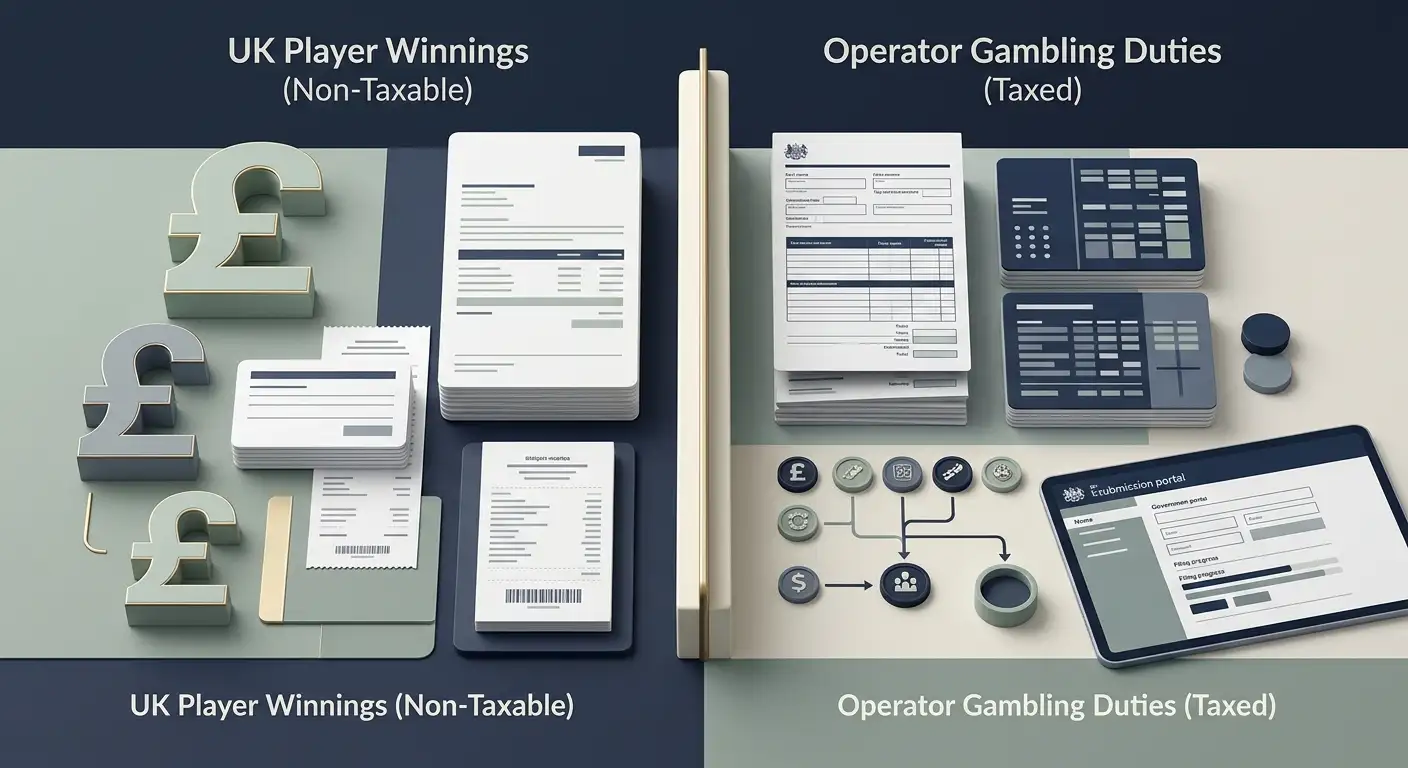
Player winnings and operator duties answer different questions
| Topic | Who it concerns | General UK position |
|---|---|---|
| Ordinary casino winnings | Player | Generally not taxed as trading income for an ordinary player. |
| Ordinary gambling losses | Player | Generally no tax relief for losses incurred by an ordinary player. |
| Remote Gaming Duty | Operator (gaming provider) | Charged on gaming provider’s profits from remote gaming with UK persons. Rate rises from 21% to 40% from 1 April 2026 (GOV.UK). |
| Other UK gambling duties | Operator | General Betting Duty, Pool Betting Duty, Bingo Duty, Machine Games Duty and Lottery Duty apply to other licensed gambling activity; not paid by ordinary players. |
The simple version: a UK player who wins on a casino game does not pay HMRC a tax bill on the win, and the operator that took the bet pays its own duty on the operator-side profit from UK customers. The two flows do not cross over.
What HMRC guidance supports for ordinary players
HMRC’s Business Income Manual uses betting and gambling examples to set out the general rule. The taxpayer who places a bet is not normally treated as carrying on a trade. As a result, the taxpayer is not taxable on betting or gambling profits as such, and is not entitled to relief for losses on the same activity. The bookmaker is taxable on profits, because the bookmaker is carrying on a trade. The same logic applies to a casino operator.
The guidance also explains that having a system, betting skill or even earning enough to live on from gambling is not, by itself, sufficient to constitute a trade of professional gambling. HMRC’s position is that gambling itself, even when conducted with care or success, falls outside trading income for the ordinary individual. That is the framework behind the “no tax on casino winnings” phrase commonly repeated in UK material.
Several situations move away from that ordinary-player frame and are not covered by the same general position. Professional services, business structures, employment income paid in gambling form, appearance fees, spread-betting products with financial-services characteristics, crypto-asset disposals, residence questions and overseas income each have their own treatment. Where those questions arise, qualified personal tax advice is the appropriate next step rather than a general casino guide.
Remote Gaming Duty: the operator-side number
Remote Gaming Duty is an HMRC duty charged on a gaming provider’s profits from remote gaming where the gaming is with UK persons. It applies to remote casino, remote bingo and other remote gaming activity covered by the duty. The duty is paid by the operator, not by the player, and is calculated against the provider’s gaming profits rather than against any individual customer’s win.
GOV.UK guidance confirms that the Remote Gaming Duty rate rises from 21% to 40% with effect from 1 April 2026. That is an operator cost increase, with potential downstream effects on operator economics, product design and pricing. It is not a player tax change and does not introduce a new tax bill for UK customers on their winnings. Even after 1 April 2026 the ordinary-player position above continues to apply: a player who wins on a UK-licensed casino game still does not face HMRC tax on the win itself.
Older marketing language that compresses the gambling tax landscape into a single “tax-free winnings” slogan creates two related risks. It can read as a financial-incentive promise, which UK advertising codes do not permit. It also conflates the ordinary-player position with the operator-side duty, when those are separate flows under HMRC’s framework.
Why tax wording should not become marketing copy
UK gambling marketing has to be socially responsible and comply with the CAP and BCAP advertising codes. CAP Code Section 16 (gambling and lotteries) prohibits framing gambling as a solution to financial difficulty, as a route to financial freedom or as a way to enhance personal qualities. A tax statement can be factually accurate and still cross into prohibited territory once it is wrapped in promotional language.
For ordinary readers, the safer reading is the precise one. Ordinary UK player winnings from gambling are generally not taxed as trading income. Ordinary losses are generally not relieved. Operators pay their own gambling duties. None of those points is a reason to take up gambling, deposit at a particular operator, claim a bonus or treat gambling as a financial strategy. The point of the page is to clarify the distinction, not to frame it as an incentive.
Where the tax point sits in the Aspers context
The Aspers Online operator-side duty question is now moot: Aspers Online (Malta) Limited’s Casino Remote licence under UKGC account 61021 is recorded as Revoked – Non Payment of Fee, with a To date of 1 December 2025. There is no current GB remote casino activity under that account to generate Remote Gaming Duty against UK persons. The full record is set out on the UKGC licence record page.
The ordinary-player tax point still has a Stratford-side relevance, because Genting Casino Stratford is a current operating venue at Westfield Stratford City under Genting Casinos UK Limited (UKGC account 537, non-remote). The ordinary-player position applies the same way to a player who wins at the venue: the win itself is generally not subject to UK income tax as trading profit, and the venue operator pays its own gambling duties. The Stratford context page covers the venue side; this page stays with the tax framework.
General context only, not personal tax advice
This page is general information for ordinary UK readers researching the casino winnings tax question. It does not address the specifics of any individual case. Anyone whose situation differs from the ordinary player frame – including professional gambling activity, corporate or partnership structures, overseas residence, spread-betting products, crypto-asset disposals, source-of-funds enquiries, welfare-benefit interactions or insolvency proceedings – should seek qualified personal tax advice rather than rely on a general explainer.
The general framework is robust enough for the ordinary case: winnings from normal gambling activity sit outside trading income, losses are not relievable, and operator-side duties are paid by the operator. The facts of a more complex situation can move the answer materially, which is why the boundary matters.
Public records used for this page
- HMRC Business Income Manual – betting and gambling guidance for ordinary players.
- GOV.UK gambling duties – including the Remote Gaming Duty rate change to 40% from 1 April 2026.
- HMRC Remote Gaming Duty notice – operator-side duty mechanics.
- UKGC Aspers Online (Malta) Limited, account 61021 – the Aspers Online licence status referred to in context.
Where to go next
- Aspers UK guide – main hub with the overview.
- UK casino safety checks – safer research before depositing anywhere.
- Aspers UKGC record – field-by-field licence reading.
- Payment and withdrawal context – banking checks and the credit-card ban.
- How to check a UKGC casino licence – the register tutorial.
Casino Winnings Tax UK — More on this topic at aspers casino.
See also UKGC Licence Check.
Safe Online Casino UK: Licence, Payment and Safer-Gambling Checks
Content created by the «Aspers Casino» team